
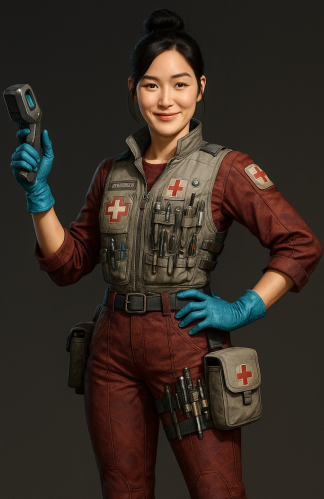

Lee Hwa-young was born in 2022 in Seoul, Korea, during a period of rising global tensions that would eventually culminate in World War III. She was the only child of Lee Joon-seok, a senior officer in the Eastern Coalition of Nations military, and a soft-spoken mother. Raised in a strict and highly disciplined household, Lee was taught from an early age to value duty, composure, and emotional restraint. Her father imposed a rigid structure on daily life, believing that strength came through silence and obedience.
Despite this austere upbringing, Lee’s mother quietly influenced her daughter’s worldview through lessons in compassion, emotional balance, and philosophical introspection. This contrast between parental figures would become a defining tension in Lee’s personal development.
At the age of eight, Lee discovered a wounded bird near her family’s garden. Though her father dismissed the animal’s suffering as a distraction, her mother encouraged her to care for it. The incident left a lasting impact on Lee, shaping her lifelong belief in the value of mercy, even in the face of futility.
In 2040, when Lee was eighteen, her mother passed away from an unspecified illness. The loss deeply affected her, creating a silence within the household that even her father could not fill. With little emotional support remaining and no clear alternative path, Lee chose to follow her father’s example by entering military service. Her decision marked the beginning of a career defined by restraint, responsibility, and an ongoing struggle to reconcile duty with empathy.
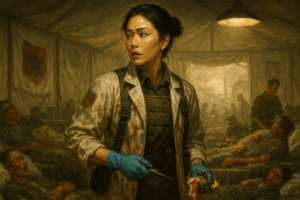
Lee began her military service in the early 2040s, joining in the military during a period of rising global tensions. Following initial training, she was trained in medical specialization, ultimately serving as a medic with a focus in trauma care and battlefield triage. Her discipline, precision, and emotional control quickly earned her recognition, but it was her uncanny ability to anticipate danger and assess risk that set her apart among her peers. This reputation led to several commendations and reassignment to high-pressure postings.
During the outbreak of World War III in 2044, she served in military hospitals. There, she treated hundreds of wounded personnel under extreme conditions, often during active bombardments. She maintained operational efficiency while under fire and frequently acted in leadership roles during triage emergencies.
In the later stages of the war, her father, General Lee Joon-seok, arranged for her transfer to a medical research post on Luna. While officially non-combat, the assignment placed her in a position of strategic oversight during the final year of the conflict.
In 2053, Lee experienced what she described as a strong intuitive sense that something was wrong. She felt an impending doom regarding he father and attempted to intervene in what she believed was an imminent threat to her father. Her warnings were dismissed. Days later, General Lee was killed and Seoul was destroyed in a nuclear bombardment. This ended her formal military career.
Lee’s service was marked by professionalism, exceptional tactical awareness, and a record of saving lives under impossible conditions. Despite her resignation from official military duty following the war, her medical and leadership skills would continue to define her postwar life.
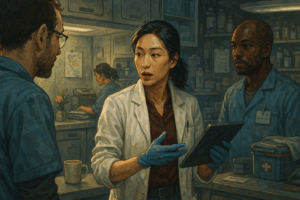
In the aftermath of World War III, Lee left military service and entered a period of civilian contract work, primarily across Luna and other system facilities. Though she had survived the war, the loss of both her father and her home in Seoul left a profound impact on her. Colleagues during this time described her not as withdrawn, but as steady, warm, and quietly empathetic, a presence many found comforting during uncertain times.
Lee remained deeply committed to caregiving, often volunteering for high-risk postings or underserved outposts where experienced medical personnel were in short supply. Her ability to stay calm under pressure and anticipate crises made her a sought-after medic in chaotic environments. She was known to spend extra time with patients others overlooked, and she built strong if transient relationships wherever she went.
She frequently moved between assignments, answering need where it arose, often without concern for her own rest or stability. She never stayed in one place long, yet those who worked with her often described feeling as though they’d known her for years.
Lee’s intuition, continued to guide her in both medical and interpersonal situations. While she never claimed to understand how or why, she often acted decisively on instinct, with results that earned her both admiration and quiet respect.
By 2058, she accepted a contract aboard the Valiant, a mid-grade cargo vessel with a reputation for running difficult routes. The post was meant to be temporary, but the dynamics aboard the ship, and something Lee herself couldn’t quite name, would eventually root her there more deeply than she ever expected.
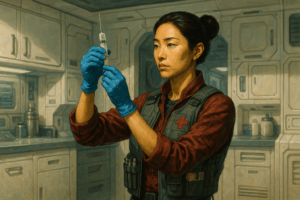
In 2058, Lee was contracted as a medical officer aboard the Valiant, a privately operated cargo vessel. Initially intended as a temporary assignment during her transition between civilian medical postings, her role quickly evolved when her professionalism, steady demeanor, and tactical insight earned the trust of Captain Jake Steele and the crew.
Lee served as the Valiant’s chief medic but was soon promoted to First Officer after demonstrating exceptional leadership in high-stress crisis scenarios. Known for her composed presence, she often acted as a stabilizing force aboard the ship, both medically and emotionally, particularly during periods of internal conflict and external threat.
Her time aboard the Valiant marked a significant turning point in her life. After years of emotional detachment and rootlessness in the aftermath of the war, Lee began to form lasting bonds with the crew. She became a key figure in maintaining the cohesion and morale of the ship during its most critical missions.
Lee’s uncanny ability to read situations and anticipate danger, widely observed among the crew but never fully explained, continued to set her apart as both a tactical and medical asset. While she rarely spoke about her past, her service aboard the Valiant began to redefine her identity, facing the possibility of healing and transformation.
 English
  한국어
한국어