
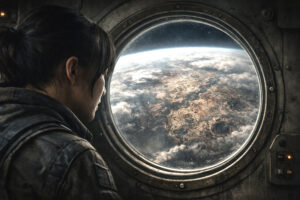
She floated closer to the glass.
The planet filled the viewport, vast and impossibly detailed, the curvature so pronounced that she felt as if she might tip forward and fall into it. Sunlight crawled across the atmosphere in thin, pale bands, illuminating storm systems that spiralled like bruises across the surface.
From up here, the damage didn’t look chaotic.
It looked… deliberate.
Great swaths of land now discoloured, ashen scars where impact zones and atmospheric burns had rewritten the geography. Cloud cover hung thick over entire regions, fallout particles still trapped in endless circulation. Where oceans showed through, they reflected no vibrant blue, only a muted, metallic sheen, like tarnished steel.
Almost as if someone had gotten tired of the original structure and decided to give the Earth a facelift -and then botched the procedure. Thinking about it now, that’s exactly what happened.
She tried to pick out familiar borders. Tried to find something that still looked like home. It was harder than she expected.
Six years had passed since the final exchanges, but from orbit, the war didn’t feel finished. It only looked paused, as if the planet itself were holding its breath, waiting to see if humanity would survive what it had done to itself. And then, what’s coming next.
Sora rested her hand lightly against the cold glass. The surface below felt distant in a way no shuttle ride or transport ascent briefing could have prepared her for. She had spent her whole life walking that world, breathing its air, fighting in its ruins, pulling survivors from its wreckage.
And now she was above it.
Looking down.
Trying to reconcile the idea that somewhere on that broken surface was a place still meant to save them all. She adjusted her stance as the ship made a subtle rotational correction, thrusters firing in short, controlled bursts.
The stars shifted as Earth drifted. And slowly, through a break in the cloud systems over the Midwest Exclusion Zone… Something began to rise into view.
The heaters along the bulkhead struggled against the cold bleed of space, leaving the air thin and metallic in Sora’s lungs.
She stood alone anyway. Earth filled half the viewport.
Even after three years on refugee retrieval routes, the sight of it still hollowed her chest. Storm systems the colour of bruises crawled across continents. Vast grey plumes smeared the atmosphere where old impact zones still bled particulate ash. The oceans, or rather, what could be seen of them, reflected no blue, only a dull iron sheen beneath the cloud cover. It felt like an illustration out of a college textbook -a reminder of sorts. Humanity had not lost the war in a single moment.
After that colossal level nuke. It eroded.
Burned cities. Famine spirals. Infrastructure collapse. Then the exchanges, orbital and terrestrial, that finished what the rest had started. Six years later, the planet looked less like a home and more like a warning.
Sora adjusted the magnification ring along the viewport.
The clouds parted over the Midwest Exclusion Zone, revealing a scarred expanse of blackened land where Lake Michigan’s shoreline had partially receded into irradiated marsh. Ruins of Chicago’s outer districts lay fused into glassy plains.
And rising from that devastation, there it was. The Gate.
Even from orbit, it commanded the eye. The megastructure pierced the cloud layer like the spine of some impossibly large creature, its base swallowed by atmospheric haze while its upper tiers glittered in reflected sunlight. Terraced bands wrapped the tower’s circumference, agricultural rings glowing green against the dead world below. Solar membranes fanned outward like translucent wings. Condensation arrays shimmered as they drew water from poisoned air.
A vertical civilisation. Self-contained. Self-sustaining.
Untouched.
“Hard to believe, isn’t it?” Sora didn’t turn. She’d heard Corwin approach and seen him in the reflection on the glass. “It looks…” She searched for the word. “Clean.”
Corwin stepped beside her, folding his hands behind his back as he studied the tower. Unlike most crew, he watched The Gate with familiarity instead of awe. “It is clean,” he said. “Air filtration at ninety-nine point eight percent efficiency. No surface contaminants past Tier Twelve. You could walk barefoot up there.” Sora glanced sideways. “You have?” “Twice. Intake liaison runs.” A faint smile. “You’ll see soon enough.”
Below them, a glint of motion broke from the station ring encircling The Gate’s upper atmosphere, a docking strut rotating into alignment with orbital traffic. Station traffic. A soft chime sounded overhead.
DESCENT WINDOW CONFIRMED. LANDING POD ONE PREPARED.
Sora exhaled slowly. One pod. Three seats. One chance down, and back up. Terribly inefficient, but it got the job done. Behind them, through the pressure hatch, she could hear intake crews guiding the refugee forward.
Morg.
He’d been silent since retrieval. Pale, thin, hollow-eyed, clutching onto a sealed data shard since the moment he was found like the entirety of his existence depended on the thing. Another survivor pulled from the wasteland, promised sanctuary inside humanity’s last functioning paradise.
Sora looked back at the tower. Sunlight broke across its upper tiers, scattering gold across the viewport. For a moment, although almost like an illusion, Earth didn’t look dead.
It looked… hopeful.
She rested her hand against the cold glass as the ship began to reorient for descent burn.
“Let’s hope, it’s everything they say it is,” she murmured
Corwin didn’t answer right away. When he did, his voice was quieter. “It is,” he said.
A beat.
“It has to be, it’s all we’ve got.”
The descent alarm began to sound.
It started as a low chime somewhere deep in the ship’s structure, soft enough to be mistaken for background systems at first before rising into a steady, pulsing tone that reverberated faintly through the observation blister floor.
Operational. Measured. Final.
It could be felt more than heard.
Corwin pushed off the bulkhead first, boots catching the mag-strip along the deck as if the shift from stillness to motion had already happened in his mind minutes ago. “That’s us,” he said, almost absently. “We’ve got a twelve-minute deployment window.”
Sora took one last look at the planet before turning away.
From this distance, The Gate still looked like salvation. She followed him through the pressure hatch and into the spine corridor that led toward the launch ring. The ship’s internal lighting had shifted from its usual soft white to descent amber, a subtle but unmistakable sign that flight operations had priority control.
Crew moved with quiet efficiency around them, securing equipment, locking bulkheads, and running final diagnostics on systems that would remain in orbit. Nobody rushed. Nobody spoke loudly. The Valiant had done this dozens of times. Routine for them.
Not for her.
They passed through a circular junction where the artificial gravity gradient thinned toward microgravity. Sora felt her stomach dip slightly as her boots adjusted magnetically to the deck plating. Ahead, through a reinforced viewport, she saw the landing pods for the first time up close.
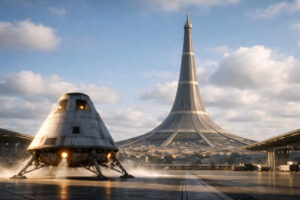
A Pod sat locked into its deployment cradle like a bullet seated in a chamber, compact, armoured, all angles and heat shielding. Its hull plating bore the scorched discolouration of repeated atmospheric entries, burn marks layered over one another like growth rings. Beside the cradle, still attached along the ring’s opposite axis, sat B Pod.
Identical in shape, but pristine. Unused, like it was just waiting.
Sora slowed unconsciously as they approached. “That’s the one that goes down, right?” she asked, nodding toward A Pod.
Corwin glanced back briefly. “A Pod handles surface descent and launch. B Pod stays docked until recovery alignment.”
She stopped walking entirely, studying the two crafts. “They’re the same design.” “Structurally, yes. Functionally, not on this mission profile.” He keyed his clearance into the bay console, and the inner blast doors began cycling open with a heavy mechanical thrum.
“Think of A Pod as the lander,” he continued, gesturing toward the scarred craft. “It’s built to survive atmospheric entry, landing stress, and surface operations. But fuel capacity is limited, most of its mass is shielding and structural reinforcement.” “And B Pod?”
“That’s the booster.”
They stepped through into the launch bay proper. The space was impossible, ringed with articulated mechanical arms, fueling conduits, and magnetic clamp arrays that held A Pod in place. Through the open launch aperture beyond the containment shield, Earth hung vast and silent. Technicians floated along tether lines, completing final hull inspections. Corwin led her along the gantry toward the pod access ramp.
“Once we land,” he said, “A Pod powers down into low-consumption standby. It holds enough fuel for ascent burn, but not enough to achieve orbital velocity on its own.” Sora frowned. “So how does it get back up here?” “It doesn’t,” he said simply. “Not alone.” They reached the pod’s exterior hatch.
Up close, the scale shifted, what had looked sleek from afar now felt dense, industrial, as if built for punishment rather than comfort. Corwin placed his palm against the hatch scanner but didn’t open it yet. “Recovery works in stages,” he said. “Firstly, we’re on a timer from the moment we land, and we must prioritise that time while carrying out our assignment. Once surface operations are complete, the timer runs out and an automated request for launch authorisation from The Valiant is sent. That authorisation is tied to orbital positioning.”
He pointed past her, toward B Pod on the far side of the ring.
“B Pod detaches hours later and manoeuvres into a descending rendezvous orbit, not all the way to atmosphere, just low enough to intercept our ascent trajectory.” Sora followed his gaze, picturing it. “So we launch… and meet it on the way up?” “Exactly. A Pod burns everything it has to reach intercept altitude. B Pod handles the rest, from docking, stabilisation, to the insertion burn that carries both pods back to full orbit.”
“And if B Pod isn’t there?”
Corwin didn’t answer immediately.
Instead, he keyed the hatch controls. Hydraulic locks disengaged with a heavy clunk, and the door began to iris open. Inside, the cabin lighting flickered to life. Then he spoke.
“If B Pod isn’t there,” he said, “A Pod runs out of fuel before orbital velocity. We’d reach peak altitude… stall… and fall back into atmospheric decay.”
Sora absorbed that in silence.
“So the launch window isn’t flexible.” “No,” he said. “It’s precise. We can’t just leave whenever we want. We launch when orbital mechanics say we launch, or we don’t leave at all.”
Behind them, Morg was being escorted up the gantry by the intake crew. He’d heard enough of the conversation to understand the stakes. His eyes flicked from A Pod to B Pod, then out toward the planet beyond the shield barrier. “No pressure, then,” he muttered quietly. Corwin gave a humourless half-smile. “Timing is everything.”
He paused just as they reached the hull, turning to Sora who stopped just in time to not bump into him. “Since we’re on the topic, there is one last restriction I must inform you about before we board the ship.” “What’s that?” “There’s a limited supply of fuel for this particular mission because of the increasing scarcity. There’s only so much we can use to go and return without complications, I just need you to keep that in case of an emergency.”
“Noted.”
He nods before turning back.
“Corwin?”
“Yes?” He turns again. “Do you think there’s going to be an emergency?” He pauses for a moment then shrugs carelessly. “Likelihood is 10 percent. Worst-case scenario, our refugee doesn’t like his new home and we’ll have to call for an intervention.” “Hmmph. What happens then?” “Nothing, he’d just be convinced or coerced into a compromise.” She nods. “Fair enough.”
They boarded.
The interior of A Pod was tighter than Sora expected; three acceleration couches arranged in a triangular configuration around a central avionics column. Every surface was functional: harness rigs, emergency rebreathers, manual thruster overrides. No wasted space. No comfort considerations. She strapped into the forward couch as Corwin moved through preflight checks with practised familiarity.
Outside the viewport, the launch bay began to retract its service arms. Magnetic clamps rotated A Pod slowly into deployment alignment.
A procedural voice filled the cabin.
VALIANT DESCENT CONTROL. POD ONE, YOU ARE CLEARED FOR DEORBIT SEQUENCE.
Corwin’s hands moved across the console.
“Clamp release in thirty seconds,” he said. “Once we detach, we’ll manoeuvre to retrograde orientation before burn.”
Sora swallowed.
She knew what that meant now.
They had to fire engines backwards, slow themselves enough for gravity to take hold. From there… There was no turning around
She glanced sideways at Morg. He was strapped in rigidly, knuckles white against the harness grips, eyes fixed on the shrinking frame of The Valiant through the rear display feed. The ship looked impossibly far already. “First time?” she asked quietly.
He nodded once.
“Yeah.”
A pause.
“Didn’t think I’d ever leave the ground again.”
Sora didn’t answer. She wasn’t sure what comfort would even sound like up here. Corwin’s voice cut in, steady and professional.
“Clamp release in five… four… three…”
A heavy metallic jolt reverberated through the hull.
“…two… one. A Pod is free.”
They drifted. Weightless. Untethered.
For a brief moment, they were simply another object in orbit, no different from the debris fields scattered across the planet below. Then the manoeuvring thrusters fired. The pod rotated slowly, aligning its engine array opposite their direction of travel.
Earth filled the forward viewport completely now.
Corwin’s hand hovered over the burn initiator. “Retro burn in ten seconds,” he said. “This is where we commit.” Sora felt her pulse climb, not panic, but awareness.
Above them, somewhere beyond sight, B Pod remained docked. Waiting. Their only way back.
“Burn in three… two… one…”
The engines ignited.
Acceleration slammed her back into the couch as the pod began to fall. Hope, for the first time since seeing The Gate, gave way to something sharper. Tension. And the understanding that once they reached the surface… They would be operating on a clock they could neither see nor control.
The retro burn did not slow down when they expected that it would, if anything it felt like it was speeding up. And her system could only take so much. It felt like being seized. Unable to do anything but wait for it to end. Feelings oscillating between anxiety and certainty. The moment Corwin initiated the burn, the pod’s engines ignited with a force that crushed Han Sora into her harness hard enough to steal the air from her lungs. Her vision tunnelled at the edges as deceleration piled onto her chest, ribs protesting beneath the pressure.
She had experienced high-G drops planetside before, combat insertions, and emergency evacuations, but this was different by a mile.
Those had been falls, drops as they were called.
This was orbital velocity being forcibly torn away.
The hull around them shuddered as retro-thrusters roared at full output, the vibration travelling up through her spine and into her skull. Every bolt, every plate seam, every structural brace seemed to groan in protest at the physics being forced upon them.
Corwin’s voice cut through the strain, steady but louder now to compensate for the engine thunder. “Retro burn holding nominal. Velocity shedding on schedule.” Sora tried to respond but couldn’t manage more than a tight nod against the couch.
Outside the forward viewport, Earth no longer looked distant, it had begun rising. Cloud systems swelled in scale, their spiralling formations stretching wider and wider until they filled nearly the entire visual field. Lightning flickered inside storm walls like distant artillery.
Morg’s breathing had grown audible in the cabin, slow, controlled, but edged with effort. Sora forced her head a fraction sideways.
He had his eyes shut.
His face contorted into a mix of endurance and panic.
The burn dragged on longer than she expected, each passing second stretching under the weight of sustained deceleration. Then, gradually, almost imperceptibly, the crushing force began to ease.
Corwin adjusted thrust levels. “Retro complete. We are committed to descent.” The pod angled its nose forward, orienting heat shielding toward the atmosphere rushing up to meet them. For a brief, suspended moment, there was quiet. Then they hit the air.
Atmospheric entry announced itself first as vibration. A low tremor rippled along the hull, subtle but constant, like distant thunder rolling through metal. Within seconds it escalated, the pod beginning to shudder as it slammed into thicker atmospheric layers at hypersonic speed. Outside the viewport, the first streaks of plasma ignited. At the edges of the glass, faint ribbons of orange light began to curl backwards along the hull, dragged by airflow moving faster than sound could carry it.
Sora watched, transfixed despite the violence.
The glow intensified rapidly. Within moments, the entire forward view was engulfed in a raging sheath of fire, superheated ionised gas clawing across the pod’s shielding. Light flickered violently through the cabin, painting the interior in strobing gold and white.
The noise came next. Not engine thunder this time, just pure deadly friction. A deafening, continuous roar as the atmosphere resisted their passage, screaming against the heat shield as if trying to tear the pod apart molecule by molecule.
The hull temperature indicators spiked across Corwin’s console. Sora shot a panicked look his way, waiting for any indication that they were headed for certain death.
He didn’t flinch.
“Entry corridor holding. Shield integrity nominal.”
Then the comms cut. No warning, just sudden silence from external channels. Only the internal systems remained. The pod felt alone. Truly alone. Sora became acutely aware of every sound inside the cabin: the creak of stressed alloy, the hum of coolant cycling through thermal channels, Morg’s breathing, still steady and calculated, but louder now in the vacuum of lost communications.
She realised she was holding her own breath and forced herself to exhale.
The plasma storm raged on for long, relentless minutes. Then, slowly, the violence began to fade. The glow thinned from blinding white to molten orange… then to streaking embers… then to nothing but wind-scored sky. Cloud layers rushed past the viewport now, dense and grey, then breaking apart beneath them.
And through the thinning atmosphere…
She saw it.
The Gate no longer looked like a structure, it now resembled a separate world of its own, like a planet drawn out of a magazine of the before earth and yet nothing like it at the same time. Sora didn’t think anything could still amaze her as much.
“God, that’s huge.”
The tower rose through the cloud deck so tall that its upper tiers were still sunlit while its lower spine vanished into atmospheric haze. From this proximity, its scale defied easy comprehension, a vertical continent of steel, glass, and living infrastructure.
Agricultural bands wrapped its circumference in vast terraces of green, each ring wide enough to house entire districts. Artificial sunlight arrays cast warm illumination across crop fields suspended half a mile above ruined earth. Maintenance drones moved along the tower’s exterior in coordinated patterns, swarms of metallic insects repairing panels, tending condensers, servicing windbreak shields. Great veils of water poured down along atmospheric harvesting fins, captured moisture cascading into filtration reservoirs embedded along the structure’s midsections.
It was alive.
Self-contained.
Self-sustaining.
Untouched by the devastation choking the world below.
Morg leaned forward slightly against his restraints, eyes wide despite everything they’d just endured. “Yeah, that’s…” he whispered. He didn’t finish the sentence.
He didn’t need to.
Sora felt the same dissonance twisting in her chest. From orbit, The Gate had looked like hope. From here…
It looked like a separation.
As if humanity had carved out one surviving piece of civilisation and lifted it above the consequences left behind.
Corwin’s hands moved across the console again. “Approach vector confirmed. Initiating landing sequence.”
The pod adjusted orientation, nose angling upward slightly as descent velocity continued to bleed off. “Landing burn in fifteen seconds,” Corwin said. Sora felt her body tense instinctively.
If entry had been chaos… landing was definitely going to be devastatingly precise. Through the viewport, a docking platform extended from the tower’s exterior, a reinforced strut protruding from a mid-tier logistics ring. Guidance beacons pulsed in soft blue intervals, marking alignment corridors.
“Burn in three… two… one…”
Thrusters ignited downward.
Instead of crushing deceleration, this force felt steadier, controlled bursts firing in measured intervals to counter gravity’s pull. The tower grew impossibly large outside the glass.
Structural detail came into focus:
Reinforced docking ribs. Cargo elevators moving along vertical tracks. Shielded transit tubes linking external platforms to interior sectors.
“When were they able to build all this?” Sora asked, the question for no one in particular as her eyes glued to the viewport. “And how did we know nothing of it all this while?”
The pod drifted laterally, thrusters firing in short corrective bursts as automated guidance synced with tower traffic control. “Reducing velocity… aligning clamps…” A heavy mechanical arm extended from the docking strut, its magnetic couplings activating with a low electromagnetic hum that vibrated faintly through the pod’s frame.
Contact.
The impact was firm but controlled, a deep, resonant thud as the pod settled into the docking cradle. Magnetic clamps locked over the hull in sequence.
Thrusters powered down.
And then.
Silence.
Total. Absolute. Immediate.
After the violence of descent, the stillness felt wrong. Sora realised her hands were clenched tight against the harness grips. She forced them open slowly, flexing feeling back into her fingers. Outside the viewport, The Gate’s exterior stretched endlessly in both directions, a vertical city wall humming with life.
Inside the cabin, only the soft cycling of life-support systems remained. Corwin exhaled quietly. “Touchdown confirmed,” he said. “Welcome to The Gate.”
Sora didn’t answer right away. She stared out at the structure that had survived the end of the world. At the docking corridors waiting beyond the airlock. At the civilisation that, somehow, had endured.
And beneath the awe, faint, unwelcome, impossible to explain, was an unease so eerie she could hardly deny it. Instead, she brushed it off as military instinct. As if the tower were not just standing above the ruins… But watching them.
The hatch release mechanisms cycled with a slow, hydraulic patience that made the moment feel ceremonial. A pressure equalisation tone pulsed through the cabin, soft, controlled, followed by the heavy disengagement of external docking clamps. The outer iris door began to part along segmented seams, revealing a spill of warm, filtered light that cut through the dim cockpit like sunrise through a storm cloud. Sora blinked against it instinctively.
After the violence of descent, the fire, the noise, the crushing force, the stillness waiting beyond the hatch felt unreal. Corwin unsealed his harness first, boots locking magnetically to the deck as gravity normalisation engaged within the docked craft. “Atmospheric match confirmed,” he said, more to procedure than to them. “You can remove breath filters.”
Sora unclipped her restraints slowly, muscles protesting after sustained G-pressure. When she stepped down onto the pod floor, the gravity felt… softer than Earth’s. Not weaker exactly — just more evenly distributed, engineered for comfort rather than natural pull.
Morg rose last. He hesitated near the hatch threshold. His head dipped as he clutched the nearest thing to him, acclimatising to the drastic changes he’d just gone through. They stepped out together.
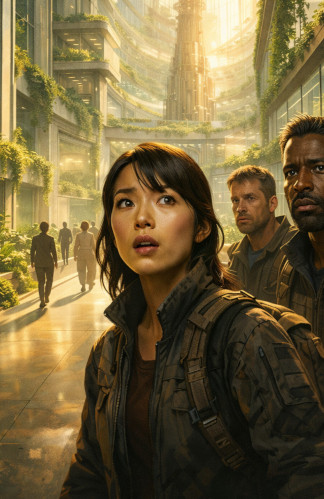
The first impression of The Gate’s interior was light.
Not harsh artificial white, but a warm, diffused glow filtered through layered atmospheric panels that simulated open sky conditions. The corridor beyond the docking bay was wide enough to accommodate cargo transports, yet it felt uncluttered, immaculate polished flooring, living plant walls running along both sides in carefully maintained vertical gardens. The air carried a faint scent of vegetation and sterilised moisture. Clean.
Cleaner than anything Sora had breathed planetside in years.
She hadn’t realised how accustomed she’d grown to ash and metal until the absence of it hit her lungs all at once.
“Wow, it’s almost hard to believe we’re back on earth right now,” she murmured.
“I’m beginning to think what’s left of earth must be a nightmare the way you keep talking,” Morg responded, clutching his shard tighter like he was certain someone would dart past and snatch it from him at any moment.
“At this point,” Sora started, looking around the vast expanse. “I’m not even sure. If all of this existed right under my nose, I’m beginning to question everything I’ve known so far.”
“You don’t have to,” Corwin adds. “This is as far as it goes, at least from what I’ve seen.”
“Last I checked, you were at the Bonaventure, your intel could be just as flawed.” Corwin shrugged. “That’s not very arguable.”
Intake personnel approached, dressed not in the military uniform Sora had gotten used to, but in soft-toned utility garments marked with Gate insignia. Their movements were calm, unhurried, their expressions composed in a way that felt practised rather than natural.
“Welcome to The Gate,” one of them said gently. “Please follow the intake guidance line.” A subtle light band illuminated along the corridor floor, guiding them forward. As they walked, Sora took in the details.
Citizens moved along adjacent walkways, some in work attire, others in civilian clothing, all of them healthy, clean, and emotionally even.
No raised voices.
No visible arguments.
No security patrols. No weapons.
After years in refugee zones where tension lived just beneath the skin of every interaction, the quiet here felt almost staged.
Morg walked slightly behind them, turning his head as he studied everything, infrastructure seams, surveillance nodes disguised in ceiling architecture, and the placement of intake drones floating silently along the corridor perimeter. They were not unobserved.
Not for a second.
Intake processing began in a circular assessment chamber divided into three stations. The procedure was clinical but not cold.
Medical scans came first, full-spectrum imaging arcs that passed over their bodies in slow, humming rotations. Contamination purges followed: sterilised mist fields designed to neutralise radiological and biological surface exposure from the wasteland. Sora endured it without complaint, though the vulnerability of standing motionless while machines read every metric of her physiology made her uneasy. Corwin handled it with procedural familiarity.
Morg did not.
When the chemical inoculation phase began, a stabilisation injection delivered at the base of the neck appeared automatically and Morg pulled back instinctively. “What is that?” he asked.
“A regulatory serum,” the intake medic replied calmly. “It assists with atmospheric acclimation and neurochemical stabilisation.” “I don’t need it.” “It is mandatory for all new arrivals.” He shook his head, stepping back another pace. “You said this was a medical screening.” “It is.”
Two additional attendants stepped closer, not aggressive, but firm.
Sora started to intervene verbally, but Corwin gave a slight shake of his head. Procedure. Required. “We’re on a timer, our instructions are to make sure the refugee is well settled and return before we miss our opening. There’s no room for escalation.”
She paused, her whole body tensing as if calculating his words carefully before relaxing. “Fine, but something seems… off.”
“It’s psychological. Not much of this makes sense after the devastation we’ve witnessed over the last couple of years, the paranoia you feel is unfortunately natural. I felt it too during my first visit.”
Morg’s resistance lasted only seconds more before sedation protocols engaged, a brief pressurised injection delivered through his forearm restraint when he attempted to pull away. His body slackened almost immediately. They eased him down onto the med platform with practised care.
“The sedation is temporary,” the medic assured. “He will be fully conscious within the hour.”
Even with Corwin’s logic, Sora didn’t like how routine it sounded.
Once stabilised, Morg was separated from them for refugee-specific intake evaluation. Unlike liaison transfers, refugee integration required deeper psychological and vocational assessment before tier placement. He was wheeled through a secondary corridor flanked by translucent partition walls.
It was there, in the brief window before the doors sealed, that he saw the others. A small group of refugees he’d spoken with during orbital transit.
A woman with radiation scarring along her jawline. A father travelling with his teenage son. An older engineer who had shared dehydrated rations with Morg during intake holding. They stood together near a junction threshold, escorted by Gate personnel.
They looked calmer than he remembered.
Sedated, perhaps.
The father met Morg’s eyes briefly, recognition flickering there for a second before intake attendants guided them toward a separate corridor branching away from the main processing. Morg managed to lift his head slightly from the transport gurney.
“Where are they going?” he asked, voice still dulled from sedation. The attendant guiding his platform didn’t break stride. “They are being reassigned.”
The words landed strangely.
“Reassigned where?”
No answer came immediately. Just the quiet hum of corridor lighting and the soft glide of the transport platform.
Finally: “To an area more suitable for their integration needs.” The corridor doors closed behind them with a muted seal.
Morg twisted weakly to look back to the room they’d come out from, catching a quick glimpse of something out of place on the floor before the door sealed shut.
Sora and Corwin completed their own baselining shortly after. Psychological mapping came last, non-invasive neural scans paired with behavioural response prompts. Emotional variance, stress thresholds, and cooperative alignment markers, all recorded without commentary.
Overseeing the entire process was a senior intake official.
After their evaluation, he approached them and introduced himself only as Stability Liaison Director Hale. He carried himself with composed reassurance, hands folded loosely behind his back, voice warm but measured. His presence felt less like security and more like administration. “You will find life within The Gate highly structured,” he explained as their assessments finalised and they waited to confirm Morg’s status. “Stability is the foundation upon which our survival rests.”
Sora studied him carefully. “And if someone struggles to adapt?”
Hale’s expression didn’t change. “Then we ensure they are reassigned to roles more conducive to collective harmony.”
The phrasing seemed more like an echo, a practised line to keep anyone from further questions. Clinical. Gentle. Final.
Sora filed it into the back of her mind where she kept the other natural paranoia.
Later, when Morg was returned to them, he was fully conscious as promised but quieter than usual, Sora was the first to notice the change.
She’d expected by now he would’ve come to terms with the idea of being part of this utopia, especially after being through such hell. Instead, he seemed increasingly suspicious by the second, and kept glancing down corridors as if mapping exits. As if tracking who passed… and who didn’t.
“Is everything alright, Morg?” Her eyes studied him carefully as she asked, and he merely nodded. Corwin, as if finally catching on also paused to look at him. Finally, he decided to yield, but his voice stayed low when he spoke. “The people I came in with,” he said. “They moved them somewhere else.” “Different intake tier, probably,” Corwin offered. Morg shook his head slowly. “They didn’t take their bags.” That detail lingered for a long, silent minute.
“You didn’t come here with any bags yourself,” Corwin responded, his voice somewhere between worry and growing suspicion. “I know, but they did.” “How do you know that?” Sora asked, looking around to make sure they weren’t calling any attention to themselves.
“Because when I met them earlier they had their possessions clinging to them like a lifeline, and before you say it got lost in transit, I saw something that looked familiar in the office where they were screened.”
“Something?” Now it was full-on disbelief in Corwin’s voice. “I can’t tell for sure since I could barely keep my head up at the time but I’m pretty sure I got a glance at one of their bags.
A beat.
Finally, Corwin sighed. “We’ll look into it, but I can assure you you’re simply reading too far into this. Just do as they say for now and we’ll ask around about these friends of yours.”
As intake processing concluded, they were guided deeper into the residential tiers, past luminous garden walls and calm civilian walkways, into the heart of humanity’s last surviving sanctuary.
Everything was perfect. Ordered. Peaceful. But behind them, down a corridor now sealed and forgotten by the system… A group of new arrivals had been quietly redirected. No announcements. No explanations. Only a word spoken softly enough to sound merciful.
Reassigned.
And though life inside The Gate moved forward without disruption…The suspicion lingered. Now amongst three of them.
Unresolved.
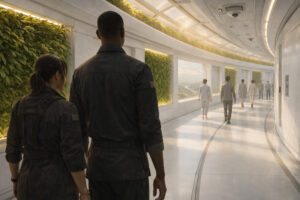
The guest quarters sat along a mid-elevation habitation ring, high enough that atmospheric haze softened the ruined world below into distant abstraction, but low enough that the agricultural terraces above still filtered warm, artificial sunlight down through layered glass. It felt like living inside a controlled sunrise.
The corridors were wide, gently curved, lined with living plant walls whose leaves shifted subtly as climate systems regulated airflow. The temperature never wavered, not warm, not cool, but perfectly balanced in a way that made the body relax whether it wanted to or not.
Even the soundscape was engineered.
No echo. No machinery noise. No distant clang of industry.
Only soft footfalls and quiet conversation.
Sora and Corwin were assigned adjoining guest suites, compact but meticulously designed. Adaptive lighting panels adjusted automatically to circadian rhythms. Nutritional dispensers embedded into the walls offered personalised meals calibrated from intake scans. Sora stared at the food the first time it materialised on the tray, fresh greens, protein lattice, warm bread cultured from synthetic yeast strains.
It looked… normal.
More normal than anything she’d seen in a while, in fact, calling it normal might just be wrong by current standards. Not rationed. Not packaged. Not improvised from wasteland salvage. Just regular food.
She took a bite. It tasted better than anything she’d eaten in years.
And somehow, that made her trust it less, where could they possibly be getting the resources for all this? Everything was destroyed six years ago, infrastructure and vegetation alike. And yes there’s been recovery since then but this place seems like it’s fifty years apart from the rest of the world.
“You don’t like the food?” Corwin asked when he walked into the dining area with his own tray. Sora shook her head. “I love it.”
Corwin paused. “You sure have a strange way of showing it.” He took a seat across from her.
“Doesn’t any of this bother you?” Sora asked suddenly, looking away from her food and at him. “What are you referring to?” Corwin responded without bothering to look away from his meal. “This! All of this. It’s too clean, too quiet, too normal to be real.”
Corwin sighed.
“I already told you-” “I don’t think I’m just struggling to adapt, Corwin. Something’s off with this place, I can feel it.” “Well if that’s the case, we’re not in the business of politics, we just have to complete this mission and go back to base.”
Sora paused, then picked up her spoon before pausing again. “And what Morg said? About those folks being reassigned?”
“What about it?” “You don’t think it’s a bit suspicious, what could they possibly be reassigned for? This is supposed to be a refuge.”
“It is, but it is primarily a system and systems run under certain protocols. I honestly believe Morg blew the whole thing out of proportion. He’s not very trusting that guy.”
Sora scoffed, taking another bite of her meal. “Can you blame him?”
Morg, meanwhile, had been taken deeper into integration processing. Refugee intake, they were told, required extended psychological mapping before residential assignment. It was explained as necessary, ensuring each new arrival could adapt to the emotional equilibrium that The Gate depended on.
After Morg’s earlier concerns, both Sora and Corwin found themselves watching everything more closely. Not openly suspicious, but alert in a way they hadn’t been upon arrival. And under more pressure from Sora, Corwin finally agreed to check things out.
When they were done eating, they walked the residential tier together under the pretence of orientation familiarisation. “Security presence?” Sora asked quietly. Corwin glanced around. “Minimal.”
“Minimal?” she repeated. “Or nonexistent?”
He didn’t answer immediately.
Because she wasn’t wrong.
There were surveillance drones, discreet, ceiling-mounted observation nodes, intake monitors embedded in corridor intersections, but no armed patrols, no visible enforcement presence. Because clearly there was no need for them.
No one was arguing, or shouting. No visible unrest of any kind. Nothing about that was normal, no matter how much it seemed so. “How does a population this dense stay this calm?” she murmured. “Chemical regulation helps,” Corwin said, nodding subtly ahead.
She followed his gaze.
The wellness stations were built directly into public transit corridors. Tall, cylindrical vapour columns lined the walls at regular intervals, glowing softly from within. Citizens stepped into them voluntarily, some alone, some in pairs, standing still as translucent mist filled the chamber around them. Soft light pulsed. Wristbands along their arms interfaced with the column’s control ring, displaying dosage metrics in calm, scrolling text.
Emotional variance.
Stress index.
Neurochemical balance.
Sora watched as one citizen stepped out, exhaling slowly, expression peaceful, almost serenely blank. “They’re drugging them?” “More like they’re drugging themselves,” Corwin countered. “That’s messed up, Corwin. And liaison allows this?” “What are they supposed to do? It’s working, the system is working and no one is complaining.”
“Of course, no one is complaining, look at them! Just a bunch of zombies with dampeners slapped on their emotions, this isn’t right.”
Corwin paused for a moment, turning to look at her. “This is a sensitive topic for you isn’t it?” Sora fell silent, her jaw clenching. “It has nothing to do with me, I’m worried about these people.”
Corwin looks away, not convinced but willing to let it go. “I understand how you feel, regardless if doesn’t change the fact that it’s a voluntary process, and because of that there’s nothing we can do about it.
A beat.
“How often?” she asked. “Daily, hourly, who knows?” Corwin replied. “Either ways it’s supplemental if emotional spikes register above acceptable thresholds.”
“And everyone agrees to this?” “I would.”
Sora’s head snaps to him. “Look, these people have been through hell and managed to survive, psychedelics to help with the stress might not sound like such a bad idea. And it’s not framed as control,” he said. “It’s framed as wellness. After the war, emotional destabilisation caused riots, sabotage, and population collapse inside early shelters. The Gate engineered a preventative model.
Sora watched another citizen enter the column.
No hesitation. No coercion.
Just compliance.
She realised then that the inoculation she’d received during intake hadn’t fully metabolised yet. Because she could feel something shifting inside her now. Subtle. Like the edge had been taken off her thoughts.
The anxiety she’d carried since descent, the unease, the hyper-awareness, had dulled slightly.
Everything felt… easier to process. Clearer.
But also flatter.
As if emotional depth had been sanded down to prevent friction.
She didn’t like it.
Her eyes snapped to the band on her wrist and in a single abrupt move, she reached for it and tugged with enough strength to snap it loose. “Aissi.”
Corwin studied her for a moment, didn’t say anything and looked away.
Morg’s evaluation chamber sat several tiers below, a controlled psychological assessment suite built from curved glass partitions and neural interface consoles. He was seated upright now, sedation long worn off, though the lingering heaviness in his limbs hadn’t fully faded. Screens surrounded him, projecting adaptive simulations designed to test stress response, authority compliance, and cooperative instinct.
An evaluator spoke calmly from behind the glass. Asking questions that oscillated between odd, fascinating, and outrightly diabolical. Questions about food rationing, scarcity and redistribution, about his responses if anresident exhibits emotional volatility, about compliance to instructions without explanations and countless other things. Morg answered, but not always the way they wanted.
His distrust surfaced repeatedly. He questioned policy logic. He asked what happened to those who couldn’t adapt. Each deviation flagged his file incrementally. He noticed the markers accumulating in the corner of the console display.
Further Review Recommended.
The session was nearing its conclusion when suddenly a loud sound intruded on the eerie calm. The office door slammed open hard enough to echo. Everyone in the chamber turned.
A young man in his early twenties at most, staggered into the evaluation suite clutching a crude, makeshift weapon assembled from maintenance scrap and conduit wiring. His breathing was ragged, eyes wide with panic rather than calculated aggression. “Where is he?!” he shouted. Security hadn’t reached him yet, that alone was shocking. “Where did you put him?!” Evaluators remained seated, composed.
One rose slowly, palms visible.
“Please lower the device. You’re experiencing distress-” “Don’t give me that crap!” the young man screamed, voice cracking. “You took him! You reassigned him and he never came back!”
That word again, it hit Morg like a physical jolt.
Reassigned.
“I want to see him!” the man continued, advancing a step. “You said it was a temporary placement! You said-”
Security drones entered silently from ceiling ports, small, efficient, non-lethal containment units. The young man barely noticed. “Where is my father?!”
The drones deployed sedation pulses in synchronised bursts. The makeshift weapon clattered from his grip as his body seized briefly, then collapsed. Containment personnel moved in immediately, restraining him with practised gentleness as sedation deepened. He kept struggling weakly even as they lifted him. “You said he’d come back…” His voice faded as he was carried out.
The chamber returned to silence within seconds.
Controlled.
As if the outburst had been nothing more than a procedural interruption. But Morg couldn’t look away from the doorway where the man had vanished.
Reassigned.
And never seen again.
In the aftermath, evaluators stepped out briefly to confer.
For the first time since entering the chamber… Morg was alone.
The surveillance nodes still watched, but the primary console in front of him remained active, his assessment file open within the system. He glanced toward the glass partitions.
No one was immediately present. Slowly, he reached into the inner lining of his intake garment. The shard rested where he’d hidden it. He slid it into the console’s auxiliary port. The interface resisted for half a second… Then accepted the connection.
Data pathways unfolded across the screen, infrastructure routing, reassignment logs, nutrient allocation matrices. He didn’t have time to search. So he copied everything. Every accessible file. Every hidden directory he could breach in the window he had.
Transfer progress crawled.
Thirty percent. Fifty. Seventy.
Footsteps approached outside the chamber. He disconnected the shard just as the door slid open again. The console reset to evaluation display. No evidence visible. But his pulse hadn’t slowed, because now he knew two things for certain:
People who were reassigned didn’t come back.
And whatever reassignment meant…The system didn’t want it questioned.
The evaluators resumed their seats, and the session continued. But Morg’s answers grew quieter after that. More careful. Because suspicion had turned into fear. And fear, inside The Gate… Felt dangerous.
The hydroponic terraces were suspended halfway between The Gate’s residential tiers and its agricultural superstructure, a transitional space where engineered nature blurred the line between habitation and production. Sora hadn’t meant to come here. But after hours of walking corridors that felt too controlled, breathing air that felt too processed, she found herself following the soft pull of humidity and chlorophyll until the architecture opened into green.
The terrace stretched outward in layered platforms, each one dense with cultivated growth, leafy vegetables, fruiting vines, nutrient mosses spreading across vertical racks in carefully regulated patterns. Overhead, artificial sunlight panels simulated late afternoon warmth, casting long golden beams through drifting vapour irrigation.
Water moved everywhere, flowing like rivers, misting, condensing, trickling down transparent filtration tubes that fed root systems embedded in aerated nutrient beds. It was beautiful. And deeply unsettling.
Because it worked.
Because life thrived here while the world below starved.
Sora rested her hands on the railing overlooking the lower terraces, watching automated pollination drones drift lazily between flowering crop clusters.
“You been thinking about what I said earlier too?”
She didn’t startle. Morg’s voice had that quiet weight to it now, the tone of someone who had stopped expecting comfort from answers.
She turned slightly as he approached. He looked different from the way he had during intake. Not physically although the nutrition and medical stabilisation had already begun restoring some colour to his skin, but there was just something different to him. His eyes moved constantly now, tracking infrastructure lines, irrigation conduits, structural seams. Analyzing.
“You finished the evaluation?” she asked.
“For now,” he said. “They said I’m pending secondary review.”
“Pending? What’s that supposed to mean?” Morg looked away, his jaw clenching. “Whatever it is, it can’t be good.”
They stood in silence for a moment, the only sound the gentle hiss of vapour irrigation cycling across the terrace.
Then Morg spoke again. “I saw something again,” he said. Sora glanced at him. “From intake?” He nodded. “What happened?” “Remember those ones I told you about before, the ones who got reassigned?” His jaw tightened slightly.
“In the evaluation office. A man came in, looking for his father. Said he’d been reassigned too, and he never saw him again.” Sora didn’t interrupt.
Morg continued, voice low but steady. “They sedated him. Took him out like he was malfunctioning equipment.” He rested his forearms on the railing, staring down at the crops below. “I’ve been in hydro systems my whole life,” he went on. “Closed-loop agricultural environments, population shelters, nutrient recycling grids… I know how resource math works.” He gestured faintly toward the terraces. “You can’t sustain output like this without input. Not at this scale. Not in a sealed ecosystem.”
Sora felt the unease she’d been holding at bay begin to sharpen again. “You think they’re hiding food reserves?” she asked. He shook his head slowly. “No. I think they’re hiding something worse than that.”
The words landed heavily between them.
Before she could respond, Morg reached into his intake garment and withdrew the shard he’d smuggled through processing. “I copied infrastructure flow data during my evaluation,” he said quietly. “Nutrient routing. Waste allocation. Processing outputs.”
He held it out to her. “I don’t have clearance to access system overlays… but you do.” Sora hesitated only a second before taking it. The shard felt warm from body heat, a wide, fragile object carrying implications far heavier than its weight.
Behind them, the terrace access doors slid open. Corwin stepped out, spotting them immediately. “I thought I’d find you two near the plants,” he said, half-smiling. “Hydro engineers gravitate toward oxygen.”
Morg didn’t return the humour.
He pushed off the railing and turned fully toward him.
“People who fail reassessment don’t come back,” he said bluntly.
Corwin’s expression shifted, not dismissive, but guarded. “You already said that, Morg.” “And you dismissed me.” “I didn’t dismiss you, but I didn’t address it either because that’s just an assumption.”
“It’s not- not anymore.” “Morg-”
“I found the logs,” he pressed. “Output increases after reassignment cycles. Nutrient yield spikes that don’t correlate to agricultural input.” Corwin folded his arms, thinking rather than reacting.
“In a closed system,” he said carefully, “reassignment can mean a lot of things. Labour redirection. External exile. Deep maintenance placement. Not everyone can live in residential tiers.” “So they just disappear?” Morg shot back. “They’re relocated where they’re most useful.”
The phrasing hung there.
“You sound just like them.”
“I sound logical, maybe that’s the pattern you’re missing.” His jaw clenched.
Sora stepped in before the tension escalated. “I can check the routing data,” she said, lifting the shard slightly. “Liaison credentials should show us infrastructure flow.” Corwin exhaled slowly. “Alright,” he said. “Let’s look before we jump to conclusions.”
They accessed the system from a mid-tier maintenance terminal overlooking the terrace irrigation spine. Sora slotted the shard into the console port. The Gate’s network interface unfolded in layered schematics, a three-dimensional infrastructural map so dense it resembled a living organism more than architecture.
She navigated as much as she could access, overlaying Morg’s copied routing data onto official infrastructure channels. At first, nothing seemed unusual. Waste processing plants. Water reclamation grids. Organic recycling loops are standard to any closed ecological structure.
Then she narrowed the filter. Biological output vs registered population loss. Her fingers slowed. “That’s… off,” she murmured.
Corwin leaned closer.
The discrepancy wasn’t small. Biological processing output exceeded projected civilian mortality rates by a significant margin, far beyond what natural death or medical waste could justify. “Could be agricultural imports,” Corwin suggested weakly. “There are no imports,” Sora said quietly. “It’s a closed system.” Sora traced the routing paths downward.
Every flagged data stream converged along the same infrastructural descent channel, deeper than residential, deeper than agricultural, beyond standard maintenance clearance.
The sector label appeared in sterile system text:
NUTRIENT PROCESSING: SUBSTRUCTURE LEVEL B
She attempted to open the sector schematics.
ACCESS RESTRICTED. STABILITY AUTHORIZATION REQUIRED
She tried alternate liaison credentials. Denied. Even infrastructure visuals beyond that junction blurred into anonymised routing blocks, deliberately obscured.
“That’s as far as my clearance goes,” she said.
Corwin studied the screen, jaw tight.
“So we have excess biological material,” he said slowly. “Being routed to a restricted nutrient facility we can’t access.”
Both of them turned to each other, suspicion clear as day on both their faces. “Morg already said it would take something a lot bigger than what’s on the surface to feed all this,” Sora said, gesturing toward the endless terraces. “And whatever is beneath the surface, it can’t be good if all these measures are being taken to keep it from public access,” Corwin responded.
Silence settled between them.
Like a final fracture of certainty.
Sora logged off the system. Her unease had hardened into something sharper now, suspicion anchored by data. “Restricted nutrient processing in a sealed population ecosystem,” she said quietly. “That’s not standard sustainability.”
Corwin didn’t argue this time. He just watched the substructure label glowing faintly on the console display. Because whatever lay beneath that access wall… The Gate didn’t want it seen.
And now neither of them could stop thinking about it.
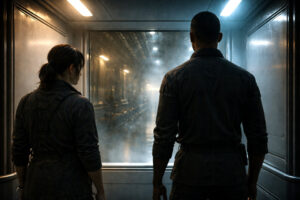
Morg’s summons came sooner than any of them expected.
The notification arrived as a soft chime through the guest suite interface, polite in tone, sterile in phrasing.
REFUGEE INTEGRATION CANDIDATE MORG: FINAL EVALUATION SCHEDULED.
DIRECTORIAL REVIEW AUTHORIZED.
ESCORT ARRIVAL: TEN MINUTES.
Sora read it twice.
“Directorial review?” she murmured. Corwin looked up from the terminal where he’d been reviewing mission timelines. “That’s higher than standard intake,” he said. “Most refugees clear through first-tier evaluators. Director-level review means an interview with Hale.”
“More like interrogation,” Morg murmured.
Sora didn’t like the sound of that.
Outside the suite’s panoramic wall, the hydroponic terraces glowed under simulated daylight, mist drifting in slow, tranquil veils. Inside, tension thickened the air. Morg sat on the edge of the adaptive sleep platform, hands clasped together, eyes distant.
“We’re the last evaluations that bad?” She asked quietly.
Corwin hesitated, just long enough to answer honestly without alarming them. “We shouldn’t be worried, it probably means they want final clearance before residential assignment.” “That’s not what it means,” Morg said.
No one argued.
After the escort personnel arrived and took Morg for evaluation, the suite fell into an uneasy silence. Corwin was the first to break it. “We need to start prep for departure,” he said, pulling up orbital alignment data. “Our return window opens in twelve hours. B Pod will begin descent manoeuvring nine hours from now. If we miss intake completion, we miss recovery alignment.”
Sora barely looked at the display.
“All that nutrient routing data goes somewhere,” she said instead.
Corwin exhaled slowly. “Sora-”
“Excess biological output. Restricted substructure. Population reassignment cycles.” She turned toward him fully. “You don’t find that concerning?” “I find it incomplete,” he replied. “We don’t have proof of anything.” “And Morg’s evaluation intrusion? The son looking for his father?” “That can only be tagged as some sort of emotional distress, not evidence.” Sora stepped closer to the viewport, staring out at the endless agricultural tiers. “Something is feeding this system beyond standard waste recycling,” she said quietly. “You saw the numbers.” “Yes,” Corwin admitted. “But speculation isn’t our mandate.” She turned back sharply.
“Our mandate is to deliver refugees to a sanctuary. If that sanctuary is hiding something-” “It’s not why we’re here,” he cut in, firmer now. “Our mission is intake transfer. We get Morg cleared, we log the delivery, and we leave.” “And if clearance means reassignment?”
The question hung heavy.
Corwin didn’t answer immediately. Because he didn’t have one. He ran a hand through his hair, pacing once across the suite before stopping. “Even if something is happening,” he said carefully, “we don’t have jurisdiction. We don’t have authority. And we definitely don’t have time.” Sora held his gaze.
“I’m not leaving without knowing.”
Frustration flickered across his face. “That curiosity could get us detained.” “That ‘curiosity’ might be the difference between handing them a refugee… or handing them a tool for God knows whatever they’re hiding.”
The room seemed to pause.
He looked away first. Silence stretched.
Then, quietly:
“Your liaison clearance couldn’t get past substructure filters.”
“No,” she said. “But someone’s clearance can.”
Corwin looked back at her slowly.
“You’re suggesting we steal authorisation.” “I’m suggesting we borrow access long enough to confirm what we’re dealing with.” “That’s a stability violation,” he said flatly. “So is sedating civilians and disappearing them.”
Another silence. Longer this time.
Finally, he exhaled through his nose.
“You realise if we’re caught, we don’t just miss the launch window. We might not leave at all.”
“Won’t be my first rodeo.”
He studied her for a long moment.
Then nodded once. “Alright,” he said quietly. “We do it clean. No alerts. No trace.”
The opportunity came faster than expected. Mid-tier administrative corridors were quieter during evaluation cycles, most officials occupied within intake review chambers, including Director Hale’s office where Morg was currently undergoing assessment.
Sora and Corwin moved through the corridor with measured calm, liaison badges visible, posture relaxed enough to avoid scrutiny. Two intake officials stood near a security junction console reviewing assessment logs, both carrying the authorisation bands they needed clipped along their utility sashes.
Corwin slowed subtly as they approached.
“Let me do the talking,” he murmured under his breath.
Sora nodded once. “Wouldn’t have it any other way.”
He stepped forward, adopting the practised tone of bureaucratic familiarity. “Apologies,” he said, gesturing toward the console. “We’ve been asked to verify intake routing for refugee candidate Morg. Director Hale’s review flagged data inconsistencies.”
Both officials looked up, mildly surprised but not suspicious.
“Routing inconsistencies?” one repeated, already turning toward the console display. Corwin stepped closer, pointing toward fabricated data overlays he’d pulled up on his wrist display. “It’s probably nothing,” he said casually. “But I’d rather resolve it before departure clearance locks our documentation.”
As he spoke, Sora moved behind them, posture calm, movements unhurried. Her eyes locked on the bands, just one should do, and given her experience with stealthy maneuvers this shouldn’t be so hard. She timed it with Corwin’s gestures, his body blocking the line of sight just long enough.
Her fingers slipped toward the authorisation band.
Almost swiping it off
Then the other official shifted suddenly.
Not fully turning, but enough to catch her from the corner of his eyes. His hand snapped down over his sash. Eyes narrowing.
“Hey! What are you doing?,” he said sharply.
The second official turned as well.
Recognition flared too quickly.
Corwin reacted first. He drove his elbow back into the nearer official’s diaphragm, knocking the breath from him before he could trigger an alert. Sora moved instinctively, grabbing the second official’s arm as he reached for his wrist console and slamming him hard into the corridor wall. The impact dazed him but didn’t drop him. He struggled, trained enough to resist, untrained enough to lose this fight. Corwin recovered fast, striking a nerve cluster at the base of the man’s neck. Both officials collapsed within seconds.
The corridor fell silent again.
Sora stood frozen for half a breath, adrenaline roaring in her ears.
“Well,” Corwin muttered, catching his breath, “so much for clean.”
They moved quickly after that. Authorisation bands removed. Bodies were dragged into a nearby maintenance alcove. Corwin sealed the access hatch behind them and looped internal surveillance feeds for the corridor.
Sora clipped the stolen clearance band onto her wrist.
It activated instantly, and she met Corwin’s eyes
“No turning back now.” He gave a tight nod. “Then let’s find out what The Gate is hiding… before Morg’s evaluation ends.”
Together, they turned toward the restricted transit lift leading down into substructure levels. Into the part of the tower no guest was meant to see.
The restricted transit lift required authorisation confirmation before it would even move. Sora’s stolen clearance band handled it without protest. She turned to Corwin with a look of relief. “Good, I was scared they might’ve been restricted too.” The doors to the lift sealed shut and began to descend. “I doubt it, I’m pretty sure every one of these officials knows what’s going on. It’s the only way they can keep anyone from finding out whatever’s going on down there,” Corwin replied.
The motion was smooth, almost gentle, but the atmosphere inside the cab shifted perceptibly as they dropped below the inhabited tiers. The lighting dimmed first. Not dramatically, but enough that the warm daylight spectrum of the residential levels gave way to cooler industrial illumination, pale, functional strips embedded in the lift’s ceiling. Then the air changed. Sora noticed it instinctively, heavier, humid with processed moisture and something faintly metallic beneath it. Not the clean, oxygen-rich atmosphere of the upper tiers, but recycled air saturated with industrial runoff.
She glanced at Corwin. He’d noticed too. Neither of them spoke.
The lift continued downward longer than she expected.
Residential tiers had been layered close together, but this descent stretched on, passing maintenance levels, logistics hubs, and cargo exchange platforms before dropping deeper still. Finally, the lift slowed. A soft chime sounded.
SUBSTRUCTURE ACCESS: AUTHORIZED.
The doors opened.
And the world changed.
The corridor beyond was narrower, with raw alloy walls exposed without aesthetic covering. Overhead piping ran in dense clusters, some insulated, others sweating condensation that dripped steadily onto grated flooring below.
The soundscape was completely different.
Gone was the quiet hum of controlled habitation. Here, machinery roared. Distant turbines. Hydraulic presses. Fluid transfer pumps cycling in rhythmic surges that vibrated faintly through the deck plates. Sora stepped out slowly. “This isn’t just a preservation chamber,” she said under her breath.
Corwin shook his head.
“No… this is some hardcore infrastructure.”
They moved deeper, following directional markers embedded in the floor grid, most labelled in sterile technical code. Then Sora saw the first organic slurry conduit.
It ran along the corridor wall, a thick, reinforced pipeline filled with slow-moving, opaque biological fluid. Additional lines branched off it at intervals, each tagged with nutrient density metrics and processing timestamps.
They followed the pipeline. One corridor fed into another, each louder, more industrial, more concealed from the civilised calm above. Until the passage opened into a facility vast enough to swallow the residential tiers whole.
The bioconversion chamber stretched across multiple sublevels, a cathedral of industry built not for machines…
…but for bodies.
Sora stopped at the threshold. Her breath caught before she even fully processed what she was seeing. Processing arrays lined the chamber, long, clinical platforms where human forms lay under sterile containment fields. Automated systems moved with chilling precision, scanning, segmenting, and transferring organic material into sealed conversion tanks. It wasn’t brutal or gory like a butcher’s hut. But hell, it was a sickening process.
And like everything else in the gate they’d kept it clean.
Industrial. Sanitized. Efficient.
The bodies were treated with the same mechanical respect given to agricultural harvest stock, catalogued, processed, and repurposed. Nutrient slurry flowed outward through reinforced channels, joining the same pipelines they had followed down. Above the main processing floor, a massive system designation glowed in sterile white lettering:
HUMAN RESOURCE REASSIGNMENT: BIOCONVERSION SECTOR
Sora felt her stomach turn. “This is what ‘reassignment’ means, Corwin,” she whispered. When Corwin didn’t respond immediately, she turned to look at him.
He looked… hollowed.
As if a structural belief inside him had just collapsed. “I handled intake logistics for three years before the Bonaventure,” he said quietly. “I saw the population balance models… the sustainability projections…” He stared down at the conversion arrays. “They never showed this.”
Because it had never been meant for liaison clearance. The Gate’s sustainability wasn’t just technological. It was biological. Population recycling wasn’t a contingency.
It was infrastructure.
They began backing away slowly.
Neither speaking. Neither able to look at the chamber any longer.
But before they could reach the corridor, the lights shifted, from industrial white… To emergency red.
A low, resonant tone rolled through the substructure like distant thunder.
UNAUTHORIZED ACCESS DETECTED.
CONTAINMENT PROTOCOLS INITIATED.
Bulkhead doors slammed shut along every corridor exit. Transit lifts locked out. Ventilation systems hissed as pressurised vapour began flooding the air.
Corwin grabbed Sora’s arm. “Sedative dispersal,” he said sharply. “We need to move-”
But there was nowhere to move to.
The containment net had already closed. A holographic projection shimmered to life above the chamber floor, and Director Hale appeared, hands folded behind his back, expression composed, voice calm enough to be mistaken for reassurance.
“Hello there, it’s good to see you again,” his voice called out calmly. Sora couldn’t handle it anymore. “Why don’t you save your pleasantries for my fist you psycho?”
He seemed unfazed by her retort, if anything, he looked disappointed. “As expected, I’m sure you both must be going through a turmoil of emotions, being exposed to such… destabilising information,” he said evenly.
Sora glared up at the projection.
“You’re processing people,” she said. “We are preserving humanity,” Hale corrected gently. “Closed ecological systems require equilibrium. Emotional volatility and non-compliance threaten population survival.”
“So you recycle them?”
“We reassign them,” he said. “Their continued contribution sustains collective life.”
The sedative vapour thickened.
Sora felt the first wave of cognitive dulling creep at the edges ofher thoughts. “You don’t get to decide who lives,” she said, fighting the haze.
Hale’s expression didn’t change. “We decide who survives,” he replied. “And now… You must submit for evaluation as well. For the stability of The Gate.”
Corwin’s wrist console chimed suddenly. Through the sedation fog, he forced focus long enough to read the alert. His face drained. “Our mission timer just expired,” he said. Sora blinked, trying to process. “The rendezvous prep window-” “B Pod descent manoeuvre begins immediately,” he finished. “If we don’t get to the dock for departure, we’ll truly be stuck here.”
They’d miss recovery alignment. Meaning they’d be trapped planetside.
At that exact moment, another system notification flashed across the containment displays.
REFUGEE CANDIDATE MORG: REASSIGNMENT SCHEDULED.
PROCESSING WINDOW: FOUR HOURS.
The timing felt deliberate.
As if their discovery had accelerated his fate.
Sora forced herself upright despite the sedative thickening in the air. “We’re not submitting,” she said hoarsely. Corwin nodded, steadier than he felt. “Then we have to find a way to get out of this mess.”
Containment teams arrived within minutes, not violent, not aggressive, but absolute in authority.
Sedation cuffs were secured.
Transit restraints engaged.
They were escorted upward through restricted lift corridors, no longer guests, not yet prisoners, but categorized threats to system stability. As the lift ascended back toward the inhabited tiers, a calm public announcement echoed through the tower’s atmospheric grid.
Attention residents.
A localized stability review is currently in progress.
All systems remain under control.
Please continue normal activity.
Sora watched the tier indicators climb. Watched the tower resume its serene façade. Above them, citizens walked garden corridors unaware that bodies fed the crops beneath their feet. The lift slowed. Destination locked.
Director Hale awaited them.
And somewhere deeper below…
Morg’s reassignment clock was already counting down.
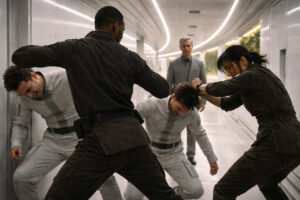
The transit restraint bands were designed to be invisible, they didn’t look like shackles or cuffs, just smooth, matte bands secured around the wrist, pulsing faintly with stabilisation light. To an outside observer, they might have passed for medical monitors or intake regulators.
But she could feel the suppression running through them. A low-frequency neural dampening that blunted adrenaline spikes and motor response, subtle enough to keep detainees compliant without visible force.
Director Hale walked ahead of them through the upper-tier corridor, security escorts flanking the trio at a measured distance.
No weapons drawn.
No urgency in their steps.
The Gate didn’t believe in chaos, even during containment.
Sora’s gaze drifted briefly to Corwin.
He caught the look. She shifted her eyes, not toward the guards, but toward the band on her wrist.
A cue.
He gave the smallest nod imaginable.
They waited.
Timing mattered more than anything else now.
Not just for escape, but for the pod window ticking down somewhere at the back of their minds.
The corridor curved toward an executive transit junction, quieter, less trafficked. Surveillance nodes still watched, but the escort formation tightened slightly as they passed through a narrow access arch.
That was the opening.
Corwin moved first.
He pivoted sharply on his heel, driving his shoulder back into the guard directly behind him before the man could react. The impact knocked the breath from the escort’s lungs and sent him crashing into the corridor wall.
Sora moved instantly. She twisted sideways, using the slack in her restraint tether to swing her bound wrists upward, snapping the destabilisation band against the second guard’s jaw with enough force to stagger him.
The corridor erupted into motion.
Hale stepped back immediately there was no panic in his eyes and his movements were a controlled withdrawal as security protocols engaged. The first guard recovered fast, lunging for Corwin, but Corwin drove a knee into his midsection and followed with a sharp elbow strike to the base of his neck.
Sora grappled with the second, smaller, faster, locking his arm and slamming him down hard against the polished floor. They weren’t soldiers. Gate security was trained for containment, not combat. Within seconds, both escorts were unconscious.
Sora dropped to one knee, breath coming fast as adrenaline tore through the dampening field still suppressing her system. “Bands,” Corwin said sharply. She grabbed the restraint seam along her wrist and twisted hard.
The destabilisation band resisted for a second before cracking loose with a sharp metallic snap. The neural suppression vanished instantly, adrenaline surging back at full force, clarity rushing in behind it. She tore Corwin’s off next. Both of them straightened, alert now, fully themselves again.
Director Hale stood several meters down the corridor, hands still calmly folded behind his back. He did not attempt to run.
“You are destabilising yourselves,” he said evenly.
Sora didn’t answer. Instead, she turned to Corwin. “We need to find Morg.”
They moved fast, but directionless at first. Every corridor looked identical when urgency stripped away the illusion of calm design.
“Docking ring is three tiers up,” Corwin said, pulling up a mission timer on his wrist console as they ran. Numbers glowed in cold countdown light. “Fifty-three minutes until intercept window.”
Sora swore under her breath.
Behind them, corridor lighting shifted, not into alarm red, but containment amber. Soft. Controlled. Inevitable. Transit lines began locking down sector by sector. They reached a junction hub just as public transport capsules sealed themselves inside docking rails, inaccessible. Atmospheric pressure fluctuated subtly, not enough to incapacitate, but enough to make running feel like moving through heavier air.
“They’re slowing our movement,” Corwin said. Sora’s lungs felt it already, the air thicker, harder to breathe.
Ventilation ports along the ceiling hissed sedative vapour.
“We need to mask up,” he said.
“Yeah, well we don’t have those.”
“Fine, then we need to run faster!”
They ducked into a service corridor just before security drones sealed the main transit artery behind them. The lighting dimmed immediately, industrial strips replacing residential warmth. Footsteps echoed louder here. Harder to hide. Corwin accessed a wall terminal mid-stride, slamming his stolen clearance band against the scanner.
“Come on,” he muttered, fingers flying across the interface. “The scanner chimed and the door slid open behind them, they hurried in instantly before the guards could reach them and pushed deeper into the service spine.
Morg stumbled into them as they stepped into the next corridor, eyes wide with panic, then recognition. “Where the hell were you guys?” Sora grabbed his arm. “You good?”
He nodded, but weakly. “I wasn’t going to sit back and find out what reassignment means, so I bolted.” Corwin nodded. “Good call, let’s get you out of this hellscape.”
The sedative saturation in lower corridors was heavier, designed for containment sweeps rather than public exposure. They pressed on anyway. Twice they were forced into brief skirmishes with containment teams, short, desperate bursts of violence where Corwin disabled drones while Sora physically engaged escorts.
Always shielding Morg.
Always moving.
They paused briefly at a junction where three maintenance corridors split vertically. Sora turned, breath heavy. “We’re guessing now.” Morg shook his head weakly. “No… we’re not.” He fumbled with his intake garment, pulling the shard free with trembling fingers. “I copied more than routing data,” he said. “Structural schematics. Blueprint overlays.”
Corwin blinked. “You what?”
Morg slotted the shard into a nearby service console.
A three-dimensional map of The Gate unfolded, layered tiers, transit shafts, docking rings, maintenance arteries.
Even Corwin looked impressed. “You stole the whole skeleton of the tower.” “Hydro engineers map systems,” Morg said faintly. “I just… mapped everything.” Corwin checked the timer again.
Forty-one minutes.
“Then find us the fastest route to Dock Ring Seven,” he said.
Morg’s hands moved shakily across the interface, highlighting a maintenance ascent shaft bypassing locked transit corridors. “There,” he said. “Direct climb. Minimal surveillance.” Sora nodded once. “Let’s move.”
They reached the docking ring battered, breathless, and chemically strained, but alive. The landing bay stretched before them, B Pod still locked in its cradle exactly where they’d left it.
For a moment, hope surged. “Hurry! We don’t have time.”
They ran toward it. Corwin hit the access console immediately. Authorisation lights flashed. Then froze. He swore.
“Launch locked, we’re too early.” “Override it,” Sora said.
“I can’t.”
He pulled up orbital alignment telemetry. “Even if I could, if we launch now, we don’t reach rendezvous altitude,” he said grimly. “We stall and fall back.”
The realisation hit all three at once. They’d made it to the pod. But escape wasn’t ready. Not yet.
“What are we going to do now?” Morg asked.
Sora turned to Corwin who sighed. “We need to buy more time.”
“How much time?” Sora groaned. Corwin stares at the timer. “About twenty-five minutes.”
“Goddamnit!”
Behind them, docking bay doors began to cycle shut as containment teams closed in sector by sector.
They were trapped between capture… And a launch window that hadn’t opened.
The launch bay trembled with distant impact reverberations as containment teams forced their way through outer access points. Magnetic door seals groaned under override pressure.
Warning strobes pulsed along the docking ring, not the frantic red of panic, but the steady amber of controlled crisis. Corwin stood at the pod console, fingers flying across telemetry overlays, trying to brute-force a launch authorisation that orbital mechanics refused to grant. It was futile and he knew it, but he couldn’t think of anything else.
“B Pod still descending into intercept vector,” he said through clenched focus. “We’re stuck.” Sora paced behind him, every instinct screaming at the narrowing perimeter “How long now?”
He pulled up the alignment clock. Numbers flashed into projection across the console glass.
RENDEZVOUS WINDOW: T-00:11:24
“Eleven minutes,” he said.
It sounded both impossibly short…
And unbearably long.
Because security was already inside the ring. Heavy containment doors along the bay perimeter slid open in synchronised sequence as stabilisation teams advanced in disciplined formation, shields, sedation rifles, drone escorts hovering in quiet support.
At their centre, walking with the same measured calm he’d carried since intake… Director Hale entered the bay.
He looked almost disappointed rather than angry. “You have destabilised yourselves unnecessarily,” he said as he approached, voice carrying easily across the cavernous chamber. Sora positioned herself slightly in front of Morg without thinking. “Aissi, You’re not turning him to food,” she said. Morg’s eyes turned to saucers behind her.
Hale stopped a few meters away. “You misunderstand our intent,” he replied gently. “Refugee candidate Morg has not yet undergone final reassignment. If you surrender peacefully, reintegration remains possible.”
Morg stiffened behind her.
“Reintegration?” he echoed.
“A return to compliant evaluation,” Hale clarified. “Stability can still be achieved.”
Sora’s jaw tightened.
“You mean sedation until he stops asking questions.”
Hale didn’t deny it.
“The Gate survives because individuals accept the needs of the collective,” he said. “You would do well to remember that.
Containment teams tightened their perimeter.
Time bled away.
Behind Sora, Corwin’s console chimed sharply. He frowned, eyes scanning a recalculated mass projection he hadn’t noticed in the chaos earlier. Then his expression changed.
Not fear. Recognition.
“Sora,” he said quietly.
She didn’t turn.
“Now’s not the time-”
“It is,” he said.
Something in his voice made her turn.
He rotated the console display toward her.
Fuel mass ratios. Ascent thrust curves. Intercept altitude margins.
And one glaring constraint.
“There’s one thing more thing I should have let you know during briefing ” he said, his voice low yet dangerously audible. “Ascent burn is designed for lighter carriage due to the mission’s success depending on one less passenger.”
Her stomach dropped as she followed the numbers.
“What are you saying?,” she asked, even though she knew. “The pod can only carry enough mass to reach intercept altitude with two passengers.”
Silence hit like a vacuum.
“And you-” Sora’s voice threatened a crack as she stood there, eyes wide. You just left that out.”
His head dips. “I’m sorry. I should’ve told you that’s why I called you outside to tell you about the fuel. I just decided to assume it was implied, to ease my conscience.
“I also should’ve told you I had unverified intel about what was going on here. And that’s why I kept stalling, why I kept hoping we were wrong.”
“Oh save your modesty, Corwin. You were just going to abandon him even though you knew?” Sora’s voice rises, flaring out of her control for a quick moment. His eyes falter for a bit and he looks away from her.
Sora’s eyes widen as the truth hits her like a flat wall. “No! You slimy brat. You can’t do this. Partners don’t do this, Talbot!” “I truly am sorry, I had to keep the truth from you so that we could focus on getting here first.”
“And if three of us go?” she asked anyway.
He shook his head. “We don’t make orbit.”
Behind them, Hale spoke again, still calm, still patient. “Please step away from the craft. This can end without further.
Corwin looked at Sora. Then at Morg. Then back at the console.
The decision happened behind his eyes before either of them could argue it, and then- He moved fast. Grabbing Sora’s arm and pulling her toward the pod hatch. “What are you doing?” she demanded. “Buying you guys time” he said. He shoved Morg inside first, then Sora after him before she could brace against the doorway. She twisted back toward the hatch.
“Corwin-”
But he was already moving.
The hatch slammed shut between them with a hydraulic seal. Sora lunged forward, slamming her palm against the inner glass. “Open it!” Corwin’s face appeared through the small viewport, calm in a way that made her chest tighten.
“Someone has to carry this out,” he said.
“Not like this!”
He ignored the protest. “B Pod needs two bodies minimum to stabilise intercept docking,” he continued. “You and Morg make weight. I don’t.” Security teams advanced behind him now, cautious but closing in.
“Why are you doing this, Corwin? I know you’re a noble man but I also know it’s not just for Morg. Your eyes are too honest.”
He sighed. “I brought a little kid here on one of my first runs. A long time ago, before the Bonaventure. I was a lot younger then, still under so much pressure from the force. So I took one look at this place, and decided it was the place for him, was jealous of him even. I left without seeing it through, I don’t know what happened to him, but I haven’t seen many kids around here since we got here, I need to find that boy, Sora.”
Sora paused, realising she’d noticed that too, but she was fighting hard against the psychedelics and hyperfocusing on everything else. “This is crazy.”
“Corwin, don’t- even if you find him, how would you help him get out?”
He reached up and manually engaged the external launch clamp override, forcing the bay’s magnetic locks to remain engaged until opened from outside.
“I’ll find my own way out,” he said.
“They’ll turn you to food if they catch you,” she shot back.
A faint, humourless smile touched his mouth.
“I’d like to see them try, this ain’t my first rodeo.”
“Corwin, you won’t survive planetside without resources.”
He paused, the smile fading as the guards closed in. “I will, as long as I know I have your back.”
Her throat tightened.
“You don’t even have to ask,” she said fiercely. “I swear it.”
He nodded once, satisfied. Then stepped back from the hatch as security flooded the bay floor behind him. “Find a radio and wait for my signal,” he said. “Don’t miss it.”
Inside the pod, the countdown ticked mercilessly.
T-00:01:12
“I won’t.”
Corwin turned to the crowd behind him, grabbing a metal pole from the ground before taking off in dashing speed, running right at them, then swerving and ducking his way through. Security teams swarmed him. He didn’t fight to win. He fought to delay.
Inside the cockpit, Sora strapped in with shaking hands as Morg secured himself beside her. “Alignment window in thirty seconds,” he said, voice thin but steady.
She powered ignition sequences.
Thrusters primed.
Guidance locked onto the rising intercept trajectory where B Pod would soon appear.
T-00:00:05
Outside, Corwin was finally overwhelmed. restrained, forced to his knees as stabilisation cuffs locked into place.
T-00:00:00
“Here we go!” Morg shouted.
Sora fired ascent thrusters.
The pod blasted free of the docking cradle in a thunderous plume of controlled flame, clearing the bay just as containment teams lost physical access.
Disabling fire followed them into open airspace, pulses streaking past the hull, close enough to rattle instrumentation but not enough to cripple thrust. They weren’t trying to destroy the pod. They wanted it intact. Wanted them alive.
The tower fell away beneath them as they climbed, agricultural rings shrinking, solar membranes folding into geometric abstraction. Fuel reserves dropped rapidly. “Burn curve holding,” Morg said, eyes locked on telemetry. “But we’re tight.”
Very tight. Then finally.
A signal pinged across the console.
B Pod.
Descending along its intercept vector like a falling star in reverse.
“Visual contact,” Sora breathed.
Docking alignment was manual at this range, automated systems were too slow for their narrow fuel margin. She guided the pod carefully, thrusters firing in precise bursts as B Pod rotated to meet them nose-first. Distance closed. Meters. Meters more
“Latching now!” Sora said. Magnetic couplings engaged with a heavy jolt. Dock secure. Seconds later, B Pod’s booster engines ignited, a deep, sustained burn that shoved both pods upward into stable orbital velocity. Earth curved beneath them once more.
They had made it.
Hours later, docked once again with The Valiant, Sora stood at the observation blister where the mission had begun. The Gate rose through the clouds below, luminous, serene, untouched by what had transpired inside its walls. From orbit, it still looked like humanity’s last miracle. A beacon of survival in a dead world.
But now she knew what sustained its gardens. What fed its people. What lay beneath its perfect calm.
She rested her hand against the glass.
And somewhere far below… Corwin remained inside that shining tower. Alive.
Waiting for the promise she intended to keep.
 English
  한국어
한국어